Why This Question Deserves a Direct Answer
Most eligibility guides for online DBA programmes are written with an MBA or general management background as the assumed default. India has an enormous population of engineers in senior technical and cross-functional leadership roles — engineering managers, technical directors, VPs of engineering, plant heads — for whom this default framing leaves a genuine, unanswered question: does a B.Tech, without a subsequent MBA, actually qualify?
The Short Answer
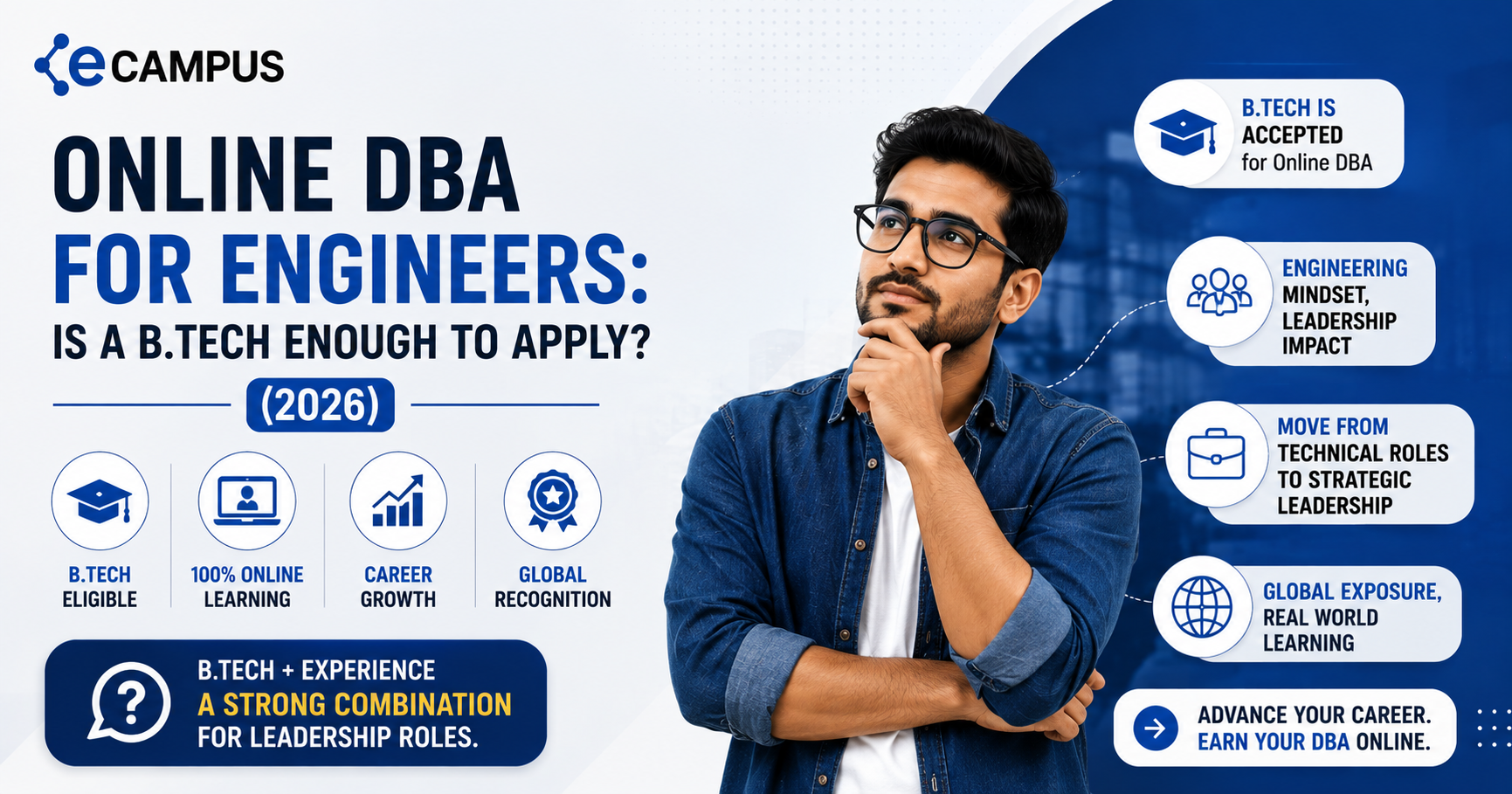
Yes, generally — a B.Tech is a bachelor’s degree, and most online DBA programmes accept bachelor’s degree holders from any discipline, provided the work-experience requirement is met. [VERIFY exact current eligibility criteria directly with your target university, as the specific structure below reflects the general pattern across several providers.]
The typical structure: a master’s degree in any discipline satisfies the academic qualification requirement outright. A bachelor’s degree (including a B.Tech/B.E.) generally requires an accompanying minimum period of relevant work experience — commonly ranging from 2 to 5 years depending on the specific university — to be admitted on the same basis.
Why Engineers Are Genuinely a Strong Fit for This Degree
Technical leaders already work in exactly the applied-problem space a DBA is built around. Manufacturing efficiency, technology adoption decisions, engineering team leadership, product development strategy — these are legitimate, substantial applied business research territories, not lesser versions of “real” management topics.
Engineering backgrounds often bring genuine research discipline already. Technical training frequently includes exposure to structured methodology, data analysis, and rigorous problem decomposition — capabilities that transfer directly to doctoral-level applied research, sometimes more naturally than a purely qualitative management background does.
The credential fills a specific, real gap for many senior engineers. A technically excellent engineer moving into broader organisational leadership (VP, CTO-track, plant head) often faces the same “you need a business credential” ceiling an MBA addresses — a DBA addresses it at a more senior level, while also producing genuine applied research grounded in their actual technical domain.
How Your Technical Experience Gets Evaluated
Years and seniority of relevant experience, generally weighted toward roles involving genuine decision-making authority and cross-functional responsibility, not just individual technical contribution.
Whether your experience gives you genuine access to a researchable applied problem. This matters specifically for a DBA — admissions committees generally want to see that you’re positioned to study something real from your own professional vantage point, not just that you’ve accumulated years in a technical role.
Your stated research direction. As covered in our guide to writing a DBA research proposal, articulating a specific, technically-grounded business question — not a vague interest in “leadership” — considerably strengthens an engineering-background application.
Choosing a Research Direction as an Engineer
This is worth addressing directly, since it’s the area where engineers sometimes struggle most in a DBA context — not because the material is too hard, but because the temptation is to research a purely technical question rather than a business one.
A DBA dissertation needs a genuine business/management dimension, not a purely engineering research question. “How to optimise this specific manufacturing process” is an engineering research question. “How organisational structure and decision-making authority affect manufacturing process adoption across multiple plants in an Indian manufacturing firm” is a DBA-appropriate business research question, even though it’s grounded in the same technical domain.
The strongest engineering-background dissertations sit at the intersection — technology adoption strategy, digital transformation leadership, engineering team structure and performance, technology-driven organisational change. This is where your technical credibility as a researcher is genuinely an asset, not a constraint you need to work around.
Specializations That Suit an Engineering Background Particularly Well
| Specialisation | Why It Fits |
|---|---|
| Technology/Digital Transformation | Direct application of technical understanding to organisational change research |
| Operations Management | Manufacturing, process, and systems background translates directly |
| Data Science / Business Analytics | Strong overlap with quantitative and technical training |
| Supply Chain Management | Especially relevant for engineers in manufacturing, logistics, or industrial roles |
| General Management | A broader option if you’re deliberately moving away from purely technical research territory |
Common Concerns Engineering-Background Applicants Raise
“I don’t have formal business coursework — will I struggle?” Most programmes build foundational management coursework into the early modules specifically because they expect a mixed-background cohort, including engineers, doctors, and other non-traditional-business applicants. This isn’t unusual; it’s expected and planned for.
“Will my research be taken seriously if it’s grounded in a technical/engineering domain?” Yes, provided it has a genuine business/management research question at its core, as discussed above. Applied research grounded in a domain you have real professional depth in is generally a stronger dissertation, not a weaker one.
“Do I need to already have an MBA?” No — this is a common misconception. A bachelor’s degree (B.Tech included) with sufficient work experience is generally sufficient on its own at most programmes
FAQs
1. Can I apply for an online DBA with only a B.Tech, no MBA?
Generally yes — a B.Tech is a bachelor’s degree, and most programmes accept bachelor’s holders from any discipline provided you meet the accompanying work-experience requirement.
2. How much work experience do I need with just a B.Tech?
Commonly 2 to 5 years of relevant experience, depending on the specific university
3. Will my dissertation need to be purely technical/engineering-focused?
No — it needs a genuine business or management research dimension, though it can and often should be grounded in your technical domain (technology adoption, manufacturing operations, digital transformation).
4. Which specialisations suit an engineering background best?
Technology/Digital Transformation, Operations Management, Data Science/Business Analytics, and Supply Chain Management all draw naturally on technical and quantitative training.
5. Will I struggle without prior formal business coursework?
Most programmes build foundational management content into early modules specifically because they expect applicants from non-traditional-business backgrounds, including engineers — this is planned for, not unusual.