A Doctor of Business Administration can be a valuable qualification for experienced professionals who want to strengthen their expertise in management, leadership, strategy, consulting, or business research. However, the growing popularity of online doctoral programmes has also made it easier for questionable providers and diploma mills to attract students.
Choosing the wrong DBA can lead to wasted money, an unusable qualification, and problems when you try to use the degree for employment, academic progression, professional recognition, or international purposes.
The good news is that there are several warning signs you can check before applying.
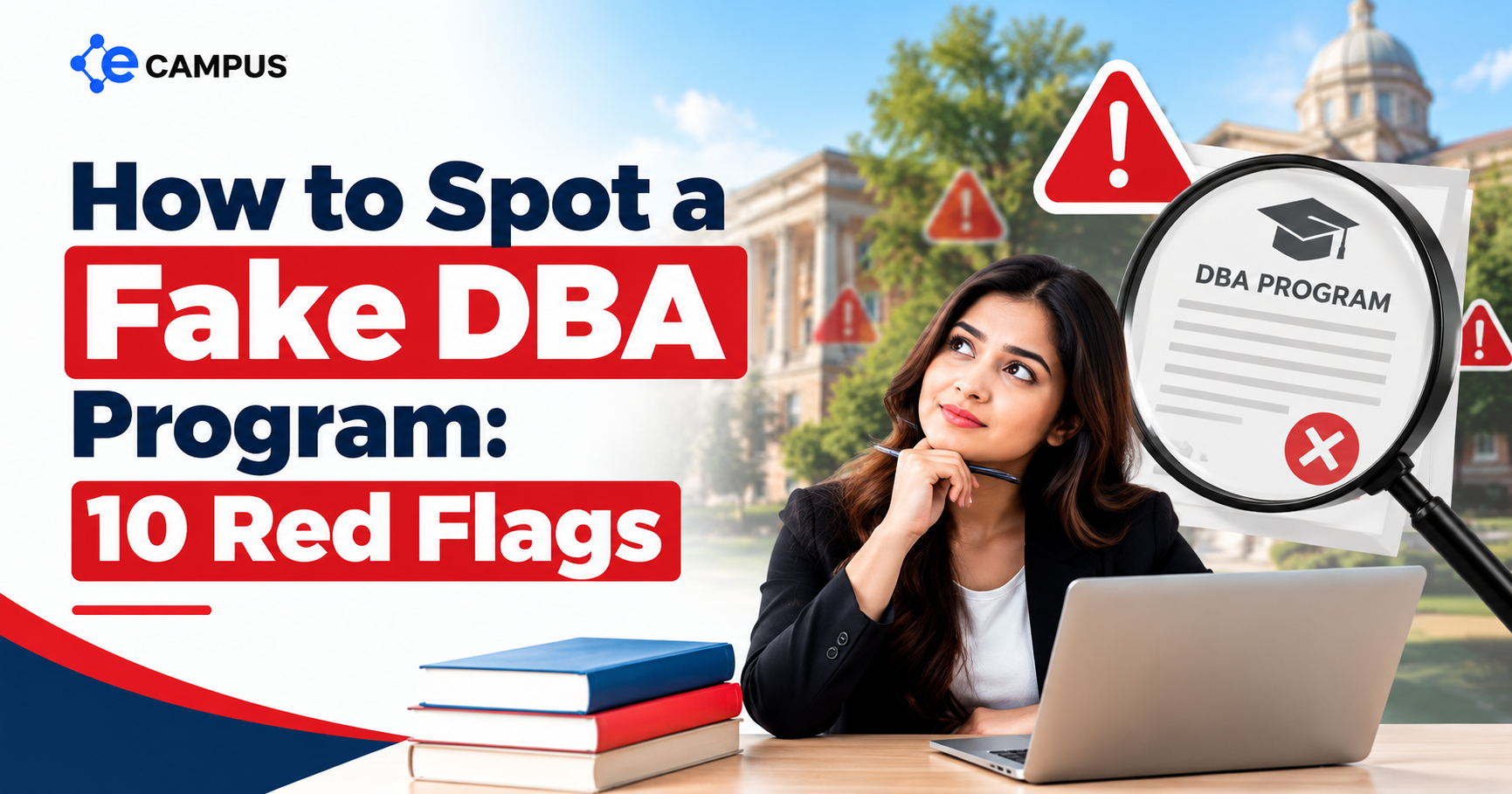
This guide explains 10 red flags of a potentially fake or questionable DBA programme and shows what students should verify before making a decision.
What Is a Fake DBA Program?
A fake DBA programme is generally associated with a provider that does not have the appropriate legal authority, academic structure, quality assurance, or recognition expected of a legitimate higher education institution.
A questionable provider may use professional-looking websites, impressive-sounding university names, international accreditation claims, and advertisements promising a doctoral degree in an unusually short period.
Not every unaccredited institution is automatically fake. Accreditation systems differ between countries, and some legitimate institutions may be pursuing accreditation or operate under different national frameworks.
However, multiple warning signs together should make you stop and investigate further.
The Council for Higher Education Accreditation identifies characteristics associated with degree mills, including unsupported accreditation claims, very short degree completion periods, minimal academic work, unclear institutional information, and degrees awarded primarily on the basis of experience or payment.
10 Red Flags of a Fake DBA Program
1. The DBA Is Promised in an Extremely Short Time
One of the biggest warning signs is a promise that you can complete a doctoral degree in a few weeks or a few months with little academic work.
A legitimate DBA normally involves advanced coursework, research training, independent study, and a substantial research project or dissertation.
If a provider says:
“Get your DBA in 30 days”
or
“Doctorate awarded within a few weeks”
you should investigate extremely carefully.
A legitimate doctoral programme requires meaningful academic engagement. The exact duration varies by institution and study mode, but a doctorate should not resemble a simple certificate purchase.
2. The Degree Can Be Obtained Mainly Through Work Experience
Professional experience is valuable for DBA applicants, particularly because the DBA is designed around applied business research.
However, there is an important difference between:
Using professional experience as part of an admission profile
and
Receiving a doctorate simply because you have many years of work experience.
A provider that says you can receive a DBA purely by submitting your CV, describing your career history, or paying an assessment fee should be treated with caution.
Recognition of prior learning can exist at legitimate institutions, but it normally follows defined academic policies and does not mean that experience automatically becomes a doctoral degree.
3. Accreditation Claims Cannot Be Verified
The word “accredited” can create a false sense of security.
Some questionable providers display logos and names of organizations that sound official but may not represent recognized accreditation.
Do not simply trust an accreditation logo displayed on a university website.
Instead, investigate:
- Who is the accreditor?
- Is the accreditor recognized by the relevant authority?
- Is the university actually listed by that accreditor?
- Does the accreditation apply to the institution or the specific programme?
- Is the accreditation current?
- Can the claim be independently verified?
CHEA specifically warns about accreditation mills that may use impressive-sounding names, unsupported recognition claims, or weak review processes.
If you cannot independently verify the accreditation, consider it a major warning sign.
4. There Is Almost No Coursework or Academic Work
A real DBA should involve substantial academic activity.
Depending on the programme, this may include:
- Research methodology
- Business theory
- Academic writing
- Literature reviews
- Research proposals
- Data analysis
- Research projects
- Dissertation preparation
- Supervisor meetings
- Dissertation or doctoral research
If a provider says you only need to attend a few sessions, submit one short assignment, or complete almost no academic work before receiving a doctoral degree, investigate further.
The issue is not whether a DBA is online.
Online does not mean academically easy.
A legitimate online DBA can still have demanding research and assessment requirements.
5. There Is No Proper Dissertation or Research Requirement
Research is central to doctoral-level education.
A DBA may use different formats for its final research project, but legitimate programmes generally require students to demonstrate advanced research capability.
Be cautious if a provider:
- Does not explain its research structure
- Has no clear dissertation or equivalent doctoral project
- Does not explain how research is supervised
- Does not provide information about assessment
- Promises a doctorate without meaningful research
A DBA without a credible research component deserves careful scrutiny.
Before applying, ask for information about the research methodology, dissertation requirements, supervisor support, assessment process, and final examination or defence where applicable.
6. Faculty Information Is Missing or Unclear
A legitimate university should normally provide meaningful information about its academic staff.
Check whether the institution identifies:
- Faculty members
- Academic qualifications
- Research interests
- Professional backgrounds
- Areas of teaching
- Institutional roles
You do not necessarily need to see a huge faculty directory, especially for a small institution. But if there is virtually no information about who teaches or supervises doctoral students, that is a reason to investigate.
Also be careful if faculty profiles contain qualifications that cannot be independently verified.
7. The University Has No Clear Legal Identity or Location
A legitimate institution should provide clear information about its identity and operations.
Look for:
- Official institutional name
- Physical location
- Contact information
- Legal or regulatory information
- Ownership or governance details
- Applicable higher education authorization
A website that provides only a contact form, generic email address, or postal box without meaningful institutional information deserves additional scrutiny.
CHEA identifies the absence of clear location and institutional information as one potential warning sign associated with degree mills.
8. The University Name Looks Suspiciously Similar to a Famous Institution
Some questionable providers choose names that resemble established universities.
For example, a provider might use a name that differs from a well-known university by only one or two words.
This can create confusion when students search for the institution.
Always check:
Is this the actual university I think it is?
Look carefully at:
- Official name
- Country
- Domain name
- Address
- Accreditation
- Institutional history
- Legal identity
Do not assume that two institutions are connected simply because their names look similar.
9. The Programme Promises a Guaranteed Doctorate
A legitimate university cannot simply guarantee a doctoral degree to every applicant regardless of academic performance.
Be cautious about advertisements saying:
“100% guaranteed DBA”
“Everyone gets a doctorate”
“No exams, no research, no failure”
or
“Guaranteed doctorate after payment.”
Admission should not mean automatic graduation.
Students should normally complete academic requirements, assessments, research, and other programme obligations before receiving a doctoral qualification.
A guarantee based primarily on payment is a serious warning sign.
10. The Website Makes Big Claims but Provides Little Evidence
A professional website does not automatically mean a legitimate university.
Questionable providers can create highly polished websites containing:
- University rankings
- International accreditation badges
- Famous-looking seals
- Student testimonials
- Claims about global recognition
- Images of impressive campuses
- Statements about international partnerships
But the important question is:
Can these claims be independently verified?
Look beyond the marketing language.
Check whether the institution’s claims are supported by reliable academic, regulatory, accreditation, or government sources.
Recent warnings from CHEA have also highlighted fake higher education and accreditation websites that can imitate legitimate organizations and use official-looking branding.
Fake DBA vs Legitimate DBA
The following comparison can help you identify major differences.
| Area | Potential Warning Sign | What to Look For |
|---|---|---|
| Duration | Doctorate completed extremely quickly | Realistic doctoral timeline |
| Admission | Degree awarded mainly for experience | Defined academic eligibility |
| Accreditation | Unverifiable accreditor | Recognized and verifiable quality assurance |
| Coursework | Little or no academic work | Structured doctoral-level curriculum |
| Research | No meaningful research requirement | Dissertation or equivalent research project |
| Faculty | Faculty information unavailable | Qualified academic and research staff |
| Location | No clear institutional address | Verifiable institutional identity |
| Degree Award | Guaranteed doctorate | Graduation based on academic completion |
| Website | Unsupported claims | Evidence-backed information |
| Assessment | Minimal evaluation | Defined assessments and research evaluation |
How to Verify a DBA Before Applying
Checking a DBA programme should take more than a few minutes.
Step 1: Verify the Institution
Find out where the institution is legally established and whether it has the authority required to operate as a higher education provider in its jurisdiction.
Step 2: Verify Accreditation
Do not rely only on the university’s website.
Identify the accrediting organization and independently verify its status and relationship with the institution.
Remember that accreditation and legal authorization are not always the same thing. A provider can have authorization to operate while accreditation is a separate matter.
Step 3: Check the DBA Curriculum
Read the actual programme structure.
Look for subjects related to:
- Research methodology
- Strategic management
- Business research
- Academic writing
- Data analysis
- Research design
- Dissertation or doctoral project
A doctoral programme should have a credible academic structure.
Step 4: Investigate the Faculty
Search for the academics who teach or supervise the DBA.
Look at their qualifications, research background, publications, and professional experience where available.
Step 5: Understand the Dissertation
Ask exactly what you will have to complete to earn the DBA.
Questions worth asking include:
- Is a dissertation required?
- Who supervises the research?
- How is the dissertation evaluated?
- Is there a proposal stage?
- Is there a defence or oral examination?
- What happens if the research does not meet the required standard?
Step 6: Check Recognition in Your Target Country
If you plan to use your DBA internationally, investigate how the qualification may be treated in the country where you intend to work or study.
This is especially important for:
- Government employment
- Academic careers
- University teaching
- Further doctoral or postdoctoral study
- Professional licensing
- Immigration or credential evaluation
- Employer verification
Recognition can depend on the purpose for which the degree is being used.
Is an Online DBA Automatically Fake?
No.
This is one of the biggest misconceptions about online doctoral education.
A legitimate university can offer a fully online DBA with online classes, digital research resources, remote supervision, and online assessments.
The fact that a DBA is online does not make it fake.
Instead, examine the institution’s:
- Legal status
- Accreditation or quality assurance
- Academic structure
- Faculty
- Research requirements
- Assessment system
- Institutional history
- Degree recognition
The question should not be:
“Is this DBA online?”
The better question is:
“Is this online DBA academically legitimate and appropriately recognized?”
What About Very Low-Cost DBA Programs?
Price alone does not determine whether a DBA is legitimate.
A low-cost programme is not automatically fake, and an expensive programme is not automatically legitimate.
However, an unusually low price combined with other warning signs should make you investigate further.
For example:
Very low cost + no dissertation + guaranteed doctorate + unverifiable accreditation
is considerably more concerning than price alone.
Always evaluate the complete academic and institutional structure.
Why Choosing a Fake DBA Can Be Risky
The consequences can go beyond losing tuition money.
A questionable DBA may create problems when you try to:
- Apply for senior positions
- Become a university professor
- Apply for another academic programme
- Obtain credential evaluation
- Submit qualifications to an employer
- Use the degree for professional purposes
- Build an academic research profile
A degree that looks impressive on a certificate may not provide the academic value you expect.
That is why verification should happen before enrollment, not after graduation.
A Simple 10-Point DBA Verification Checklist
Before paying an application or enrollment amount, ask yourself:
- Is the institution legally authorized to operate?
- Can its accreditation or quality assurance be independently verified?
- Is the DBA curriculum publicly available?
- Does the programme involve meaningful academic work?
- Is there a substantial research component?
- Are qualified faculty members clearly identified?
- Is the university’s physical and legal identity clear?
- Is the programme duration realistic?
- Are graduation requirements clearly explained?
- Is the qualification suitable for the country and purpose where I intend to use it?
If several answers are unclear, pause before applying.
Final Thoughts
Finding a legitimate DBA requires more than comparing programme titles or promotional offers.
The most important things to investigate are institutional legitimacy, accreditation or quality assurance, academic requirements, faculty, research structure, dissertation expectations, and recognition.
The biggest red flags include an extremely short completion time, degrees awarded mainly for experience, unverifiable accreditation, almost no coursework, missing faculty information, unclear institutional identity, suspicious university names, guaranteed degrees, and unsupported claims.
A professional-looking website should never replace proper verification.
Before choosing a DBA, take time to investigate the institution from independent and authoritative sources. A few hours of research before enrollment can prevent years of problems later.
Frequently Asked Questions
1. How can I tell if a DBA programme is fake?
Check the institution’s legal status, accreditation or quality assurance, faculty, curriculum, research requirements, dissertation process, programme duration, and degree recognition. Multiple unexplained red flags should be treated seriously.
2. Is every unaccredited DBA fake?
No. Lack of accreditation alone does not automatically prove that an institution is a degree mill. Accreditation systems vary by country, and some legitimate institutions may not yet hold accreditation. However, students should investigate authorization and quality assurance carefully.
3. Is an online DBA legitimate?
Yes, an online DBA can be legitimate. Online delivery itself is not a red flag. The institution’s academic structure, recognition, faculty, research requirements, and quality assurance are more important.
4. Can a real DBA be completed in one year?
Some programmes may have accelerated structures, but an unusually short doctoral programme should be investigated carefully, especially if it requires little coursework or research. A doctorate should involve meaningful academic work.
5. Is a DBA based only on work experience legitimate?
A legitimate institution may consider professional experience during admission or recognize prior learning under defined policies. However, awarding a doctorate primarily because someone has extensive work experience is a major warning sign.
6. How do I verify DBA accreditation?
Identify the accrediting organization and independently check whether it is recognized or otherwise legitimate in the relevant jurisdiction. Do not rely solely on accreditation logos displayed on a university website.
7. Why is a dissertation important in a DBA?
A DBA is a doctoral-level qualification, so research is normally a major part of the programme. The dissertation or equivalent research project demonstrates the student’s ability to investigate a business problem systematically and produce original or applied research.
8. Can a fake DBA be used for becoming a professor?
You should not assume that a questionable or unrecognized DBA will qualify you for an academic position. Universities and regulators may evaluate doctoral qualifications based on institutional recognition, accreditation, research standards, and other requirements.
9. What is the biggest red flag in a DBA programme?
A combination of guaranteed degrees, extremely short completion times, minimal academic work, and unverifiable accreditation is particularly concerning.
10. What should I do before enrolling in a DBA?
Verify the institution, accreditation or quality assurance, programme curriculum, faculty, research requirements, dissertation process, legal status, and recognition relevant to your intended career or academic use.