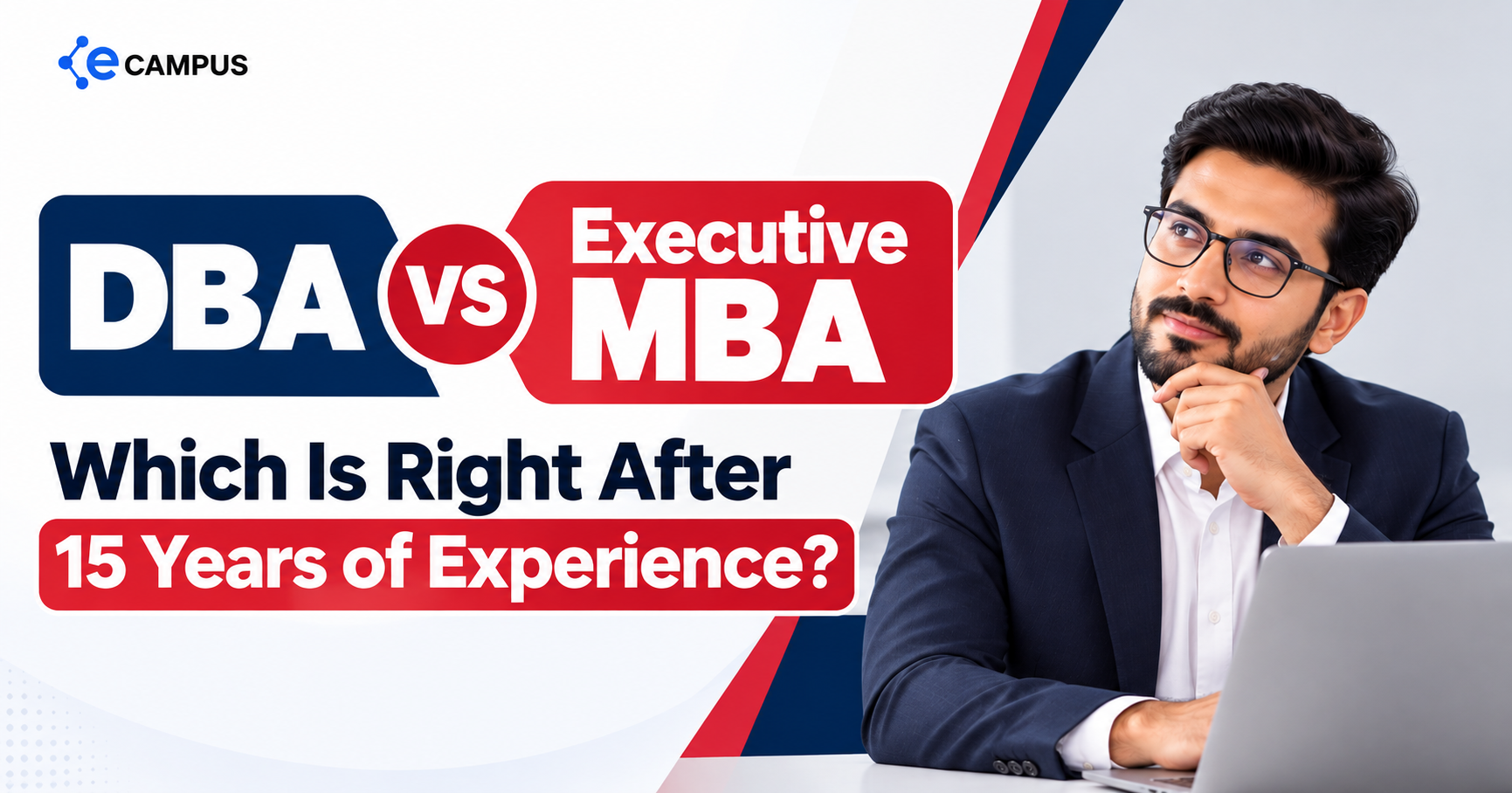
After 15 years in the professional world, you have likely developed valuable industry knowledge, managed teams, handled business challenges, and built a strong understanding of your organisation. At this stage, your next qualification should support a clear career objective rather than simply add another credential to your résumé.
Two options worth considering are the Doctor of Business Administration, commonly known as the DBA, and the Executive Master of Business Administration, or Executive MBA.
Both programmes are designed for experienced professionals, but they serve different purposes. An Executive MBA focuses on strengthening management and leadership capabilities, while a DBA focuses on advanced business research and solving complex organisational problems.
This guide compares DBA vs Executive MBA in 2026 to help professionals with 15 years of experience choose the qualification that best fits their next career move.
DBA vs Executive MBA: Key Differences
| Comparison Factor | DBA | Executive MBA |
|---|---|---|
| Qualification level | Professional doctorate | Master’s-level management degree |
| Primary focus | Applied research and business problem-solving | Advanced management and leadership |
| Ideal candidate | Experienced professionals interested in research and strategic expertise | Managers seeking broader executive responsibilities |
| Learning approach | Research methods, analysis, and dissertation | Case studies, business projects, and management modules |
| Typical duration | Around 3–5 years, depending on the programme | Around 1–2 years, depending on the programme |
| Career direction | Research, consulting, senior advisory work, and selected academic roles | Senior management, general management, and executive leadership |
| Academic workload | Substantial independent research and writing | Coursework, assignments, projects, and group activities |
| Best suited for | Professionals who want to investigate complex business problems | Professionals who want to strengthen practical leadership skills |
Programme structures vary by institution. Always check the actual curriculum, admission criteria, and duration before applying.
What Is a DBA?
A Doctor of Business Administration is a professional doctoral qualification that focuses on applying research to real-world business challenges.
Unlike a conventional management programme, a DBA requires students to investigate a specific problem, evaluate evidence, apply suitable research methods, and develop findings that can contribute to business practice.
For example, a senior operations manager might research why supply-chain disruptions continue despite investments in technology. An HR leader might examine employee retention in hybrid workplaces, while a marketing director might investigate how artificial intelligence affects customer decision-making.
Who Should Choose a DBA?
A DBA may be suitable if you:
- Already have substantial professional experience and want to deepen your expertise.
- Enjoy analysing complex business problems.
- Want to develop research-based solutions for organisations.
- Plan to build a specialist consulting or advisory practice.
- Are interested in certain teaching or academic research opportunities.
- Want to contribute original insights to your industry.
A DBA is not simply an advanced management course. It requires sustained research, academic writing, critical analysis, and independent work.
What Is an Executive MBA?
An Executive MBA is a postgraduate management programme designed for experienced professionals who want to strengthen their leadership and business decision-making capabilities.
It commonly covers areas such as strategy, finance, marketing, operations, organisational behaviour, leadership, and business transformation.
The goal is to help professionals understand the broader organisation, make better strategic decisions, and prepare for greater managerial responsibilities.
Who Should Choose an Executive MBA?
An Executive MBA may be a better choice if you:
- Want to move from middle management into senior leadership.
- Are preparing for a director, general manager, or business-unit head position.
- Need stronger financial and strategic management skills.
- Want to understand business functions beyond your current specialisation.
- Want to expand your professional network.
- Prefer structured coursework and practical business projects over a dissertation-led qualification.
For professionals with 15 years of experience, an Executive MBA can be particularly useful when the next step requires broader business knowledge rather than deeper academic research.
Which Qualification Is Better After 15 Years of Experience?
The answer depends on what you want to achieve over the next five to ten years.
Choose a DBA for Research and Specialist Expertise
Suppose you are already a senior leader, consultant, entrepreneur, or functional head. You understand your industry and want to investigate problems that existing business practices do not adequately solve.
A DBA may help you develop advanced research skills and build evidence-based recommendations. It can also support a long-term transition towards specialist consulting, thought leadership, or selected academic positions, depending on the institution and employer requirements.
However, completing a DBA does not automatically lead to a promotion or a higher salary. Its value depends on the relevance of your research, your professional reputation, and how you apply your expertise.
Choose an Executive MBA for Broader Leadership
Suppose you have spent 15 years in a technical, functional, or operational role and want to move into general management.
You may need stronger financial knowledge, strategic planning skills, commercial awareness, and experience working across different business functions.
An Executive MBA can provide a structured way to develop these capabilities. It may also offer networking opportunities with other experienced professionals.
If your main objective is to become a business head, director, or senior corporate leader, an Executive MBA may be the more direct fit.
DBA vs Executive MBA for Career Growth
Both qualifications can support career development, but the nature of that development differs.
| Career Goal | More Relevant Option |
|---|---|
| Move into general management | Executive MBA |
| Strengthen strategic decision-making | Either, depending on the curriculum |
| Build a research-based consulting practice | DBA |
| Develop expertise in a specialised business problem | DBA |
| Expand cross-functional management knowledge | Executive MBA |
| Explore doctoral-level research | DBA |
| Prepare for broader corporate leadership | Executive MBA |
| Explore eligible academic teaching opportunities | DBA, subject to institutional requirements |
These are general guidelines, not guaranteed outcomes. Your existing qualifications, employer expectations, industry, and the reputation of the institution will also influence the value of either degree.
Salary and Return on Investment
Salary should be considered carefully when comparing a DBA with an Executive MBA.
An Executive MBA may offer a more immediate route to developing skills required for a broader management position. However, a promotion or salary increase depends on available opportunities, employer policies, performance, and the quality of the programme.
A DBA may create opportunities for specialist consulting, research-led advisory work, or selected academic roles. These opportunities may take longer to develop because the qualification requires a significant research commitment and its value often depends on how the findings are applied.
There is no universal salary advantage for either qualification. Your current salary, professional sector, location, institution, and career plans all influence potential returns.
Before enrolling, compare the complete programme cost, study duration, time commitment, and realistic career opportunities. Avoid choosing a qualification based only on advertised salary increases.
Can You Pursue a DBA or Executive MBA While Working?
Both programmes can be designed for working professionals, but the study experience is different.
An Executive MBA typically includes scheduled classes, assignments, case discussions, group projects, and business-related assessments. Some programmes use weekend classes, modular sessions, or hybrid learning.
A DBA generally requires sustained independent work. In addition to any taught modules, students must develop a research topic, review existing literature, collect or analyse evidence, and complete a dissertation or equivalent doctoral research project.
With 15 years of experience, you may have valuable practical knowledge to contribute to either programme. However, consider your available time and family responsibilities before choosing a study format.
Do not assume that every online programme is self-paced or that an Executive MBA requires less effort than a DBA. Check the weekly workload and attendance expectations for the specific course.
Eligibility After 15 Years of Experience
Fifteen years of work experience can strengthen an application, but experience alone does not guarantee eligibility.
An Executive MBA commonly requires a bachelor’s degree and relevant professional experience. Some institutions may also require an interview, employer recommendation, or other supporting documents.
DBA programmes generally expect a master’s degree or an equivalent qualification. Certain programmes may consider experienced applicants through alternative admission routes, subject to specific academic and professional requirements.
Before applying, check:
- Your highest academic qualification.
- Minimum work experience requirements.
- Whether managerial experience is required.
- English-language requirements, if applicable.
- Research proposal or interview requirements for a DBA.
- Recognition and accreditation relevant to your career plans.
Five Questions to Ask Before Choosing
Before making your decision, answer these five questions honestly.
1. What is holding back my career? If you need broader management knowledge, an Executive MBA may help. If you need deeper research expertise, consider a DBA.
2. Do I want to lead business operations or investigate business problems? The former points towards an Executive MBA, while the latter may favour a DBA.
3. Am I prepared for doctoral research? A DBA requires patience, independent learning, and substantial academic writing.
4. Will my employer value this qualification? Discuss your goals with your organisation and review the requirements for the roles you want.
5. Can I justify the investment? Compare tuition, time commitment, career relevance, and realistic professional benefits.
Conclusion
For professionals with 15 years of experience, the choice between a DBA and an Executive MBA should be based on career direction rather than seniority alone.
An Executive MBA is generally the stronger option for professionals seeking broader management capabilities, corporate leadership responsibilities, and cross-functional business knowledge.
A DBA is generally better suited to experienced professionals who want to develop advanced research expertise, solve complex organisational problems, or explore research-led consulting and selected academic opportunities.
Before enrolling, compare the programme structure, eligibility requirements, recognition, study workload, and total investment. The right qualification is the one that addresses your current career needs and supports the professional future you want to build.
Frequently Asked Questions
1. Is a DBA or Executive MBA better after 15 years of experience?
An Executive MBA may be better if you want broader leadership responsibilities, while a DBA may suit you if you want to specialise in applied research, consulting, or business problem-solving. Your career objective should guide the decision.
2. Is a DBA higher than an Executive MBA?
Yes. A DBA is a doctoral-level professional qualification, whereas an Executive MBA is a master’s-level management qualification. They serve different academic and professional purposes.
3. Can I pursue a DBA after completing an Executive MBA?
Yes, provided you meet the DBA programme’s admission requirements. An Executive MBA may provide a relevant academic foundation, but the institution will determine whether your qualification and professional experience meet its criteria.
4. Which programme is better for becoming a CEO?
Neither qualification guarantees a CEO position. An Executive MBA may help develop broad management and leadership capabilities, while a DBA may strengthen research-based strategic expertise. Actual career progression depends on your experience, performance, and opportunities.
5. Which degree is better for business consulting?
A DBA may be particularly relevant for research-led consulting and specialist advisory work. An Executive MBA can also support consulting by strengthening management knowledge and business decision-making skills.
6. Can a DBA holder become a professor?
A DBA may support applications for certain academic teaching or research roles. However, eligibility depends on the institution, the role, research output, relevant experience, and applicable academic requirements.
7. Does an Executive MBA require less time than a DBA?
Executive MBA programmes commonly take around one to two years, while DBAs often take three to five years or longer. Actual duration varies by institution, study mode, and individual progress.
8. Which qualification offers a better salary?
Neither qualification guarantees a higher salary. Outcomes depend on the institution, industry, location, previous experience, current position, and how the qualification supports your career progression.
9. Can I study for a DBA while working full-time?
Many DBA programmes are designed for experienced professionals who continue working. However, doctoral research requires substantial independent study and writing, so you should check the expected workload before enrolling.
10. Should I choose a DBA mainly to use the Dr title?
It is better to choose a DBA for its academic and professional value rather than the title alone. Confirm the programme’s recognition, doctoral standards, and relevance to your goals before applying.